Showing posts with label flowers. Show all posts

Friday, September 3, 2010

Passiflora incarnata alba


The most anticipated flower in my garden bloomed today -- passiflora incarnata alba, the passion flower. I started these seeds early in the winter and have been nursing this plant along ever since, first under a cloche and then against the onslaught of the slugs.


All of my careful ministrations were worth it when when I returned from a long day of work this evening to find two blossoms quivering in the wind. The scent is tropical and the flowers look other-worldly. Neighbors gathered around for examination and discussion, as the vine is climbing my front fence. I have a feeling these passion flowers may be "shoplifted" off the vine, much like the moon flowers that grow nearby. Every morning, I notice a blossom or two has been plucked off. Such is the fate of showy flowers grown along a busy sidewalk.


I imagine a a teenage girl took one of these giant moon flowers, to tuck behind her ear, like a flamenco dancer. The petals look like rumpled white silk. I personally would pick the passion flower, although the numerous ants scurrying on the underside of the flowers would be an unwelcome surprise in the hair.

Of course, I should just rest on my laurels and enjoy the flowers, but now I am calculating the days until the first frost and wondering whether the vine will set fruit. Given the autumn chill and winds right now, it is hard to imagine I will have any passion fruit cocktails in my future. But a long Indian summer may be right around the corner, so who knows? And if not this year, perhaps next - the woman who sent me the seed says it is hardy to zone 5 if mulched carefully.

Sunday, August 15, 2010

I choose cosmos....


In his delightful gem of a book, Annuals for Connoisseurs, Wayne Winterrowd recalls an older gardener who continued to scale back her garden, bed by bed, year after year. At the end of her days, she left herself with nothing more than a single small plot of zinnias that she could see from her sitting room. "Those she could not forgo". I was utterly charmed by the idea of the flower you cannot forgo.

"All gardeners must have some one flower with which they hope to end their days", writes Winterrowd, and he himself is torn between zinnias and marigolds. I choose cosmos. Yes, they are big and bulky for a small urban garden, but their airy foliage is a delight, and their sweet flowers remind of quiet summer moments in the garden. This year, I am growing the 'Rose Bon Bon', sent to me by Renee's Garden. The double flowers are frilly and deeply colored, and make for a beautiful informal arrangement in a jelly jar.


For the garden to end my days -- and may it be a long way off! --I would pick a less showy variety, 'Antiquity' perhaps. For as Winterrowd advises, "the choice must be of something simple and naive, easy of cultivation, full of lusty good health and carrying in its open flowers a memory of all the gardens one has known and loved".

Monday, August 2, 2010

They break your heart every time


Here is my nasturtium tee-pee before I left on an out-of-state trip:


Here is my tee-pee as I found it, six days later:


Annuals break your heart every time. At some point, they just pucker out and there you are, left with the wilted, tattered remains. Have the plants reached the end of their life? Was it the heat? Was it too much rain? I am going to pick off the nasty bits tonight, and see what I can salvage. I can't leave you with the image of my sorry yellowing mess, so let me share the gorgeous centerpieces of my sister's wedding this past weekend:


These are homemade buckets of New Mexican wildflowers, surrounded by wind-fallen apples. Eat your heart out, Martha Stewart.

“I’m growing Nasturtium ‘Spitfire’ for the GROW project. Thanks, to Renee’s Garden for the seeds.”

Friday, July 9, 2010

July Surprises


This week has brought me two sets of flowers I have never seen, from my hen and chick plant and from my spider plant. The hen and chick flower stalk is a little jarring -- making for an oddly asymmetric and top-heavy container. The mother hen plant will die after flowering, but fortunately there are plenty of chicks to take over. Some folks cut the stalks off, but I will keep it for now-- I want to try my hand at collecting and germinating the seeds.


Last fall, my son rooted a spider plant baby in a little dish of dirt at the Garfield Park Conservatory. He has long since moved on to more delicious plant projects (strawberries, blueberries), but I tended this little pot all winter. Now it has started to seriously flower. There are spider plants all over my office but I can't remember ever seeing a stalk with oodles of white flowers on it --there must have been at least twenty in the first flush and you can see in the picture that more buds are forming. I put the plant on my porch for the summer, so perhaps that is why it suddenly became so enthusiastic?


The other July surprise is my sudden change in horticultural fortune. A few weeks ago, I posted grumpily about the poor performers of my summer garden. Well, those plants must have been shamed by their cyber-scolding because they suddenly are showing signs of vigor and health. Above is my newly leafing Issai kiwi vine. Here is my once-bedraggled passion fruit vine:


Even my toothache plant has started to flower abundantly with these weird, wacky globes. No wonder this is also called an eyeball plant!


Lest you think my gardening luck has completely turned around, check out my fingerling potato leaves:


Now is this blight? This humid weather is a dream for fungal infections. As I have never grown potatoes before, I also wonder if it might just mean the plant is reaching the end of its life -- it flowered abundantly about 3 weeks ago. I may turn out one container just to see. Stay tuned....

Sunday, July 4, 2010

Flowers in the vegetable garden


My nasturtium 'Spitfire' tee-pee is coming along nicely, although it may be hard to appreciate in this photo, given the visual background of vertically climbing Armenian cukes and a big zucchini muscling in from the side. The nasturtium still boasts mostly foliage, despite careful neglect with the hose and no fertilizer (the oft-recommended approach to get heavy-blooming nasturtiums). I can see lots of little buds up close, so I expect that later this week, I should have a nice tall pyramid of orange blossoms. The overall health of the plant is good, but some older leaves show a bit of curling and this patchy damage:

This nasturtium is more of a sprawler than a climber -- it has required many a twist-tie to keep the growth vertical. This last week, before long days of professional work, I had to venture out in dawn's early light to tie up more of this exuberant plant. Most folks in my neighborhood were still asleep, and there I was, trying to train a lanky, sprawling plant into a nice triangular shape.

As a passionate but harried vegetable gardener, I sometimes wonder why I put any energy into flowers -- I could have spent those precious pre-work minutes nipping suckers off tomatoes or weeding the herb bed. In his off-kilter but occasionally charming book, Joie de Vivre, Robert Arbor (with Katherine Whiteside) reports that even the most practical French vegetable gardeners -- "the crustiest old men" -- always have some annual flowers spilling out of their potager. And why not? They add color and scent to chores. This is not all for aesthetics -- nasturtiums and marigolds offer excellent companion benefits, should one believe the organic gardening folk wisdom.

Yet it is those most excellent garden writers, Joe Eck and Wayne Winterrowd, who persuade me that I am right to include flowers among my crops. They argue that for annuals like nasturtiums "their charm resides to a large degree precisely in their naivete, their simple sense of ease and well-being, just in themselves, just in what they are. It is true their colors are often bold and unsubtle....but they are beloved by children, and to any adult they offer the same kind of lift to the heart that occurs when walking through FAO Schwartz at Christmastime". And when facing a week's worth of weeds or an overgrown strawberry bed, who among us doesn't need a lift of the heart? The blooms give me courage to go forth, to carry on. And they do look nice against the cucumber leaves.

"I'm growing Nasturtium "Spitfire" for the GROW project. Thanks to Renee's Garden for the seeds.

Wednesday, June 23, 2010

Gallery of Failure


The June blossoms are cascading across garden blogs in a rainbow of colors. Gorgeous photos of lush foliage and romantic arbors are glittering through my internet browsing. I know you can shoot any garden carefully, edit well, and probably wind up with a montage somewhat able to convince the casual viewer that you reside within the pages of a gardening magazine. I don't begrudge these bloggers their brag books -- I love to see the healthy plants and flowers and to appreciate, for example, the way they have creatively planted a container.

I have been blue all week and don't have the heart to gloss over the many disasters brewing in my garden. I have decided to post my own photo gallery, but of the abject failures of June, the blights in my otherwise thriving little patch. Do I post these just to be grumpy? No. Perhaps a reader will have an idea for how to rescue the situation. Or perhaps my less-than-perfect outcome can serve as warning to others in gardens to come (Yeah, right! We gardeners never learn!).

  • The sweet pea and asparagus patch

I read in a garden book that one should grow sweet peas among asparagus plants - the flowers would wind their way up the spears and the whole effect would be quite romantic. Instead, I have an overgrown shaggy mess in the corner of my garden. Weeds are thriving, since everything is so snaggled together that any maintenance is near impossible.
  • The passion fruit vine

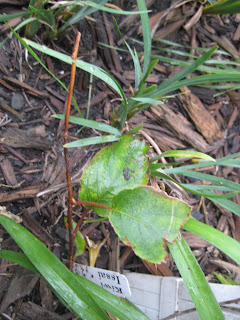
This plant seems to be the caviar of the garden for slugs and snails. I cannot keep the leaves from being shredded as soon as they emerge. This poor little seedling is the only one that has survived the onslaught -- it has been limping along for months. Now, many passiflora references attest to a "slow start" for transplanted seedlings, but this plant has literally been frozen in time since March, when I put it out under a cloche. I probably jumped the gun with the weather - but I was hell-bent on extending the growing season to see if I could get mature fruit.
  • The kiwi vine

Now, speaking of "frozen in time" this kiwi vine has done absolutely nothing since I planted it upon arrival from the Stark Brothers nursery. I followed planting directions to a T. Since the roots burn easily, I have been careful to not fertilize. Most references attest to the vine's vigor and the need to begin training the first year. Since it has less than a foot of sorry-looking growth and a few wimpy leaves, I have no idea what I am supposed to be training. Do I rip it out, or wait to see how it does next spring?
  • The toothache plant

The Spilanthes oleracea seedlings I nurtured all spring suffered mightily in the recent wet,nasty weather. Dave's Garden plantfiles reports no insect problems and "glossy" foliage, but this is a bedraggled plant that also seems to have had it's share of insect predators. I can only hope that the numbing effect of the leaves worked their magic on these pests.
  • The rose mallow
I wintersowed some rose mallow seeds and failed to do my research when transplanting the seedlings: mature height is 48"-60". I planted the seedlings in front of my peonies, and now have a silly front bed with tall, skinny plants in front of short, stout plants.

Sunday, June 6, 2010

A twisted nose


The nasturtiums are leafing out nicely. No flowers as of yet, but enough foliage to let me harvest a few leaves for a taste. Whooo-wee! Does that clear the nostrils! The nasturtium entry in Alan Davidson's essential Oxford Companion to Food remarks that the taste is similar to watercress, which is all well and good, yet he goes on to caution that the leaves should be used sparingly. That should have raised alarm bells prior to tasting these leaves.

Davidson also reports that the name means 'twisted nose' in Latin -- and no wonder! This is pungent stuff -- closer to horseradish and wasabi than arugula or watercress. I could maybe see myself tucking a few leaves into a roast beef sandwich, or rolling up some slivers in homemade sushi for a wasabi-like kick. But these zingers aren't going into my green salads -- the tender garden lettuces would be overwhelmed. I look forward to the blossoms to see if they are more or less pungent than their leafy predecessors.


On a horticultural note, the nasturtiums remained virtually untouched by pests, until a few nights ago when these little holes appeared in several leaves. I don't actually see any bugs, just their wake of (minimal) destruction. Any ideas? flea beetles, perhaps?

"I'm growing Nasturtium "Spitfire" for the GROW project. Thanks toRenee's Garden for the seeds.

Monday, May 17, 2010

Self-sowing flowers


The hot-colored blossoms of California poppies are my first harbingers of summer. There is much to recommend these easy plants; I love the ferny foliage, the silken texture of the blossoms, and the long blooming season. Multiple sources write that they make good cut flowers, though I have never had much luck. I can't say I regret that, as the informal, nodding stems seem more at home in a casual garden border than stuffed in a vase.

I first sprinkled the seed in my front bed four years ago, rather naive about the "self-sowing" qualities described on the packet. Good thing I love these plants, for eradication would be a dismal project. The seed heads are bursting with tiny seeds, readily sown by wind and gravity all over my garden and beyond. I have noticed the seedlings popping up in sidewalk cracks halfway down the block. Even in desired locations, the seedlings come up very thickly, and must be thinned aggressively for a nice display. The one year I did not thin them out, thanks to the torpor of late pregnancy, I ended up with a dense mat of underperforming, leggy plants.

Self-sowing plants entice me with their care-free attitude. If one has anxiety about formal "garden design" and or feels self-conscious about plant placement, self-sowers are an easy out; just let the plants make the decisions. And, as Joe Eck and Wayne Winterrowd point out, the plants tend to pop up just where they belong, though one would have never chosen that site intentionally.


Of course, it is a fine line between self-sowing garden plant and weed. Feverfew is rampant in my garden. I'm unsure if it was purposefully planted by the former owner, or if it is just a weed that has drifted in from surrounding areas. I can't begrudge its presence, however. It grows in the areas -- the dry and the hardscrabble -- that would otherwise be visual wastelands. The seedlings are easy to pull out, but I will leave them where they are. I have never tried it out medicinally, and am content to welcome the daisy-like flowers and pleasant citrusy scent to my "wildflower" bouquets.

This is not to say I am at peace with all self-sowers. I could do with less dill popping up all over my herb garden and, even this early in the season, I am tired of pulling out chives from every corner of my yard. A responsible gardener would deadhead these plants before they scatter their seed all over the place. But in late summer, I am charmed by the seed heads, and prefer to pay the piper later. I must also admit that a few extra dill plants-- with their airy yellow heads -- will look nice among my cosmos. I would have never thought of that.

Sunday, May 16, 2010

The Patron Saint of Lost Garden Causes


I stopped by the Kilbourn Park Organic Plant Sale today and as I was settling the bill, the cashier pointed out a forlorn group of plants. They had literally been kicked to the curb. There they sat, leggy and wilting, along the harsh sunny asphalt of the greenhouse driveway. She told me they were free for the taking and encouraged me to pick up a few. Sigh. I am not one to ever turn down a chance at plant redemption -- no matter how many bitter disappointments trail in my gardening wake.

Just moments before, I had been congratulating myself on my purchasing restraint. My garden is already bursting at the seams, and I still have many potted seedlings sitting around the patio. To further restrain myself, I had even arrived with just one $10 bill. I was careful in selecting a mere two herb plants -- anise hyssop and lovage. Both were herbs that I wanted to try out this year despite forgetting to purchase seed over the winter. Yet nothing quickens my pulse like the words "free plants" (except maybe "free seeds"). I inevitably looked over the sorry pots and found two that I didn't have the heart to abandon, a yarrow and some johnny-jump-ups. I love violas and am trying to get them to self-seed the whole northern edge of my backyard. The yarrow -- well, it looked horrible:


Yarrows are, however, such obliging plants, and do well in poor soil. After the harrowing ordeal of the porch reconstruction, my front bed is a mess of compacted, debris-laden dirt. Yarrow, peonies and poppies are my best bet at this point. I decided that a cutting-back and some gentle treatment might rescue this sorrowful specimen. If it dies, oh well! It was free. My husband just gave me a sad, unsurprised look as I came back to the car juggling an armful of pots. "Couldn't you have found more basil?" he sighed, eying the ferny, dying mess of the yarrow plant. This is what he gets for marrying the patron saint of lost garden causes. I pointed out that at least it is a cheap vice, unlike cigarettes or shoes.

Sunday, May 2, 2010

Edible flowers


Edible flowers always seem to me more of an eye-pleaser than a palate-pleaser -- while a few yellow or purple blooms can boost the visuals of a salad, I rarely find that they boost the flavor. After the "Wow! I am eating a flower" moment, I don't need to go back for another taste. A garnish of flowers is a good way to show off your chef street cred to impressionable guests. Sadly, after the oohs and aahs, usually the blooms are politely pushed to the side of the plate. Nor do I blame these diners. The candied violets I made a few nights ago -- jewels though they were -- tasted, well, sugary. Ho-hum.


In my experience, the exception to the underwhelming taste of edible flowers is the humble chive blossom. Though billed in many a garden book as imparting a "mild onion flavor" to dishes, I find the taste more powerful, closer to that of raw white onion. This strong, lingering flavor is especially prominent when still in half-bud, the tiny florets just emerging. Added to omelets or pasta, the blossoms can serve the same role as chive leaves, but with a lovely purple tint.


Many a gardening expert attests to to "spicy" punch of nasturtium flowers, which I will taste soon enough thanks to the seed GROW project. I tried to resist planting the nasturtium seed until all danger of frost had passed. But I just had so very many seeds, and with so much room for error, I had to push the limits of weather. After an overnight soak, I planted some seeds three weeks ago, and only one came up. Replacements are going into the ground this week. I was tempted to pluck one of the first tender leaves from the seedling for a quick taste, but I resisted. Soon enough I will have leaves and flowers by the bowlful. Let's hope that's a good thing for both the eye and the palate!

"I'm growing Nasturtium "Spitfire" for the GROW project. Thanks to Renee's Garden for the seeds.

Thursday, April 29, 2010

Candied violets


I have to remind myself next year to not schedule so many business trips in the tender weeks of late Spring. While in Vancouver, I missed the sprouting of the shallots, the first blossom of the Early Girl tomato, and the initial burst of intense forget-me-not blue now edging my front bed. I missed the unveiling of the 2010 One Seed Chicago plant: bee balm (I voted for it!). I also missed my husband's birthday, and while he is not one for big occasions, it is sad to pass a milestone alone in the house while son and wife are off eating halibut.

To make it up to him, I have constructed a mile-high chocolate cake garnished with candied violets from our backyard. I couldn't resist a homegrown garnish, even though the cake is replete with exotic ingredients. I had never candied violets before, and learned some lessons in the approach. The general idea is simple: coat the flowers in egg white, dust with sugar and let dry. Most recipes advise painting the egg white on with a paintbrush. I was put off by the preciousness of the individual petal painting, and was glad when I found a recipe that instructed the cook to swirl long-stemmed violets in frothy egg whites, "roll" in sugar, and dry them. Unfortunately, this method gave me a series of gloopy blossoms, barely recognizable under a thick lava of wet sugar.


When Martha Stewart tells me to do it her way, I should listen. It always works. So, I raided my son's craft box for a clean paintbrush and painted each delicate petal. I did ignore the call for superfine sugar. Regular granulated looked just fine. I organized the violets on waxed paper, snipping each stem off, and dried them in a warm oven for a few hours. Thanks to the egg white, many of the violets stuck to the paper and were too delicate to remove without incurring serious structural damage. After all of that work, I have six violets to show for it. This is all further evidence that I was not made to be a pastry chef. So I will use what I have and break out the grill. For though violet petals may be delicate, big hunks of marinated meat are not, and this is what the birthday boy wants for dinner.

Saturday, April 17, 2010

Violets and onions


The spring violets are in full bloom in my yard and they gave me cheery company as I planted onion sets this morning. I had hoped to have some "dark freckles" violets blooming among the common dooryard variety that edge my brick paths. Thanks to a high wind and a poorly anchored greenhouse, I lost all my freckly seedlings a few night ago. No matter. The common variety is the state flower of Illinois, after all. If the dooryard violet is good enough to represent my state, it should be good enough to grace the paths of my humble plot. Hopefully, the pleasant flowers will grace our dinner table as well. I plan to candy them as an edible adornment for my husband's birthday cake next week. I'll probably be the only one in my family willing to eat them.

As for the onions, this is my first go at raising them in my backyard. I generally avoid growing storage crops, thanks to the size of my yard. Unless I dedicate the entire space to a single crop, I will not raise enough to get me through a week, let alone a year. I was curious, though, about how garden-raised onions taste compared to store-bought. Moreover, alliums --both edible and decorative -- do very well in my yard (or perhaps they're just easy to grow!). I picked up some heirloom yellow onions from a garden catalog, as well as some red Italian onions from Caputo's. In price, Caputo's definitely wins: at a $1.29/lb, I bought a bunch of 50 sets for 38 cents. The catalog was nearly twenty times that price! I trimmed the roots and tops as per instructions and in they went. I planted them a little close, since I'm planning on yanking some as green onions.

I know I have barely planted enough for a pot of onion soup, but of course I have this Little House on the Prairie vision of thick onion braids hanging from my attic rafters. It was all I could do not to plant all 100 sets. I had to chant to myself "zucchini, tomatoes and peppers" over and over again, lest I forget why I was not using all available garden space for these young onions.

Sunday, April 4, 2010

Now the green blade rises

Chicago is in midst of a deliciously warm Spring, and I find it almost unbearable to have to hold on to my seed packets and not plunge all their contents into the thawing earth. Oh, the cursed phrase "after all danger of frost is past"! During cold, wet Springs, it is easy to defer the seeds and transplants, one feels so protective after a winter of careful planning. But this warm weather is bewitching...it felt like tomato and pepper season on Friday. How could there be any danger of frost when I can garden barefoot?

I have three packets of nasturtiums this year, a "jewel mix" from Pinetree and two climbing types (a home-saved "moonlight" and Renee's Garden "Spitfire"). I am tempted to select just a few from each pack and press my luck, or start some early indoors, but I will wait. I have too many garden chores ahead of me in these coming weeks to add another set of seedlings to fret over. To everything, there is a season, and for nasturtiums, it will be May.

Today I am resowing my sorrel, which did not come up, either in the cold frame or in the unprotected ground. It counts as my first failure of 2010, along with watercress (became leggy and died within a week) and Passiflora foetida (nary a seed germinated). On a more successful note, my first sowing of Cupani's Orginal sweet peas is already bursting out of the ground among the the asparagus spears. Today I am starting more sweet peas, including my windowbox mix. I will also sprinkle nigella and poppies in my front bed, and add borage and seasoning celery to my herb garden. Hopefully all this activity will slake my seed-lust, if only for a little while.

"I'm growing Nasturtium "Spitfire" for the GROW project. Thanks to Renee's Garden for the seeds.

Thursday, March 18, 2010

Spring has sprung!


Chicago is cruel in early Spring. We usually get a brief, honeyed taste of summer followed by the return of winter weather. This year is no exception: my city is currently basking in run of beautifully warm days. We are, however, facing some dips into the 20's this weekend, as well as possible snow and freezing rain. Today I could garden barefoot, wearing just a T-shirt, though the breezes still have a bit of a chill in them. The crocus bulbs came up in my lawn - could there be a sweeter harbinger of the coming season?


My plucky radishes are up, as is the wintersown mizuna.

Hopefully the seedlings will make it through the weekend chill. I will be out of town for the next week, so I won't be able to helicopter-parent them. If they all die, I have plenty of seeds to resow. My husband's parents will be babysitting and house sitting for us, and my father-in-law has more than once battled the elements in his own garden. Though he is not a vegetable gardener, he has coddled many a flower and shrub. I likely leave my seedlings in more careful hands than mine.

I take leave of the homestead with a sigh of satisfaction for, despite endless delays and permit dramas, the porch project has been completed. It was not without casualties -- the March mud combined with a week of weight from the demolition debris wrought havoc on my front bed.

The peonies had started to break through the soil prior to the project's start. They look worse for the wear, but peonies are tough old plants, so I am hopeful about their long-term prognosis.

The roses are through, but they were straggly and diseased, so I bid them adieu with a light heart. Upon my return, I will face the rebuilding of the bed. I am going to put in some perennials, start training vines and perhaps purchase a shrub or two. I will then fill in the gaping holes of this rebuilding season with annual cottage garden flowers. But who knows? I am going to Paris, so maybe I will find some garden inspiration there....perhaps I will find a small city garden or two that I can replicate on the west side of Chicago. Until then, I wish you happy gardening and a few more days like this one to get you outside and digging.

Tuesday, March 9, 2010

Early Spring


The chives are up! They are always my first edible sign of spring, cheerily growing despite frozen ground and wet, chilly air. This year they even beat out my earliest crocus. I have two large chive clumps, both of which need dividing. The soil is still too wet for me to start digging. I want to pot up one of the divisions, so that I can try to winter them over indoors next year. Right now I have only rosemary inside, and I am weary of working it into my weekly menus. Once I can harvest the chives, I will be posting my favorite recipes for my first spring herb. The other chive divisions will be given away or else scattered throughout my perennial beds, as I love the purple flowers. The only caution is their propensity to self-seed, and if you don't deadhead you will end up with many baby chives the next year.


Somehow, I don't mind pulling weeds when they are chives (maybe I can even use them for a "microgreen" garnish). My number one weed nemesis is quack grass. Along with the chives, quack grass is springing up in my perennial bed. I have been aggressively hand-pulling the rhizomes for three seasons, and I have effectively decimated the population. When we first moved in, the whole bed was an overgrown quack-grassy knoll with a dense mat of rhizomes. Thanks to heavy mulching, the rhizomes are now long and easy to grab, and I rip them out with abandon. I think of it as "aerating" the soil in my bed. To hope for complete eradication is folly, mainly because rhizomes lurk on the other side of the fence in my neighbor's yard and also under my two well established spirea shrubs. I would need to uproot my shrubs and maul the edge of my neighbors yard to really get the rhizomes out, and if I leave behind but a few snippets of rhizomes, they will inevitably pop up the next year.

I pulled the mulch off the alpine strawberries, and they look no worse for the wear. At first, I thought one had winter-heaved out of the soil, but it is actually just a dense underbelly of last year's leaf stems. I still can't tell if I needed to mulch them -- they are "alpine" after all -- but it didn't do any damage. The little baby plant that sprung up from fallen seed last fall is still doing well, so I plan to move it elsewhere. If I was nice, I would pot it up and give it away along with my chive divisions, but the berries are so delicious and small that I need every plant I can get. Even if I divide aggressively and the plants seed their little babies every season, I don't think I'll ever have enough for a bowl full of berries!

Finally, I had a longing look at my asparagus bed. Sometimes I get spears by Easter, but nothing is pushing through the earth quite yet. It is always a minor miracle the way the spears rocket out of the apparently dormant ground. There is a thick layer of composted manure blanketing the whole bed, and I have noticed that my habit of heavily layering the compost and manure in this area has raised it noticeably above the adjacent beds. All this care for a plate or two of asparagus, but what delicious plates! And who am I kidding? It rarely even gets cooked and onto a plate, as fresh-cut asparagus is a delicious raw snack. In a plot as small as mine, I focus on quality not quantity, and I would rather my son know the taste of the real stuff in small amounts, rather than enjoy weekly plates of imported spears. The asparagus has the added bonus of being quite ornamental once the harvest is over and the plants fern out. This year I am interplanting sweet peas -- Cupani's original -- to wind up the ferns. Not sure if it will work, but another garden writer wrote about this project enthusiastically. Given that this is the richest soil in my garden, it is a shame not to use it more. So the sweet peas will go in soon, but not before I relish the green snappiness of new-grown asparagus spears.

Sunday, February 28, 2010

Piquant pickle plans for 2010


After months of sitting on my shelf, some pickle alchemy has finally occurred with my green bean pickles, a.k.a. dilly beans. I hadn't even planned on pickling green beans last year, but thanks to One Seed Chicago, I had a glut of blue lake pole beans in my garden come fall. I decided to put up a few jars of dilly beans -- I love dill pickles, and I didn't feel like blanching and freezing my whole bean harvest. Dilly beans look particularly nice when canned, especially when neatly arranged in an upright but slanted pattern around the edge of the jar.


I opened a jar for company around Thanksgiving and one taste made my eyes smart: very vinegary and harsh. I was tempted to get rid of all the jars right then and there, but decided to let them mellow for a few more months and recheck. Just this weekend I sampled them again, and am happy to report that the flavor has rounded out nicely. Now, the beans are tangy and garlicky with just an edge of dill. Because the beans are raw packed prior to canning, they remain surprisingly crisp. They surpass any dill pickle you can buy at the grocery store. I have decided I need to grow dill again this summer, just to have the heads to stuff into the pickle jars. As I sit here munching on my latest culinary coup, I am pondering what pickling projects to slate for the upcoming garden season.

Last year, I canned three different vegetables: cauliflower, green beans and brussels sprouts, the latter two from my garden. In addition, I fermented a small amount of sauerkraut and a few big jars of napa and radish kimchi. I will continue on with the sauerkraut and kimchi, as well as the dilly beans, but I must be a ruthless culinary editor and nix the sprouts and cauliflower in the upcoming canning season. The sprouts were more a novelty than a real treat, and after surprising friends with a bloody mary cleverly garnished in locavore style, I ran out of uses for them. They do seem to be popular though - I recently saw a jar of pickled brussels sprouts being sold as an artisanal local product for a heart stopping 8 dollars. The cauliflower turned out better, a decent sweet and sour pickle recipe from Eugenia Bone, but if I'm doing sweet and sour pickles this year, I'm going to revive my old habit of pickling watermelon rinds.

My other definite pickling project for 2010 is going to be a foray into poor man's capers, otherwise known as pickled nasturtium seed pods. I've had my eye on this thrifty gourmet project for a while, and thus had been planning to grow nasturtiums this season. I also wanted to have a taste of the 'spicy' leaves and flowers of the nasturtium (disconcertingly, referred to as "nasties" on many a blog). Still, the main motivation was to grow a source of homemade capers. I was, then, pretty excited to hear about the seed GROW project, a communal growing project for garden bloggers, featuring no less than the mighty nasturtium. Every blogger who signed up received a packet of seeds from Renee's Garden, and will post monthly updates on the nasturtium's progress in their gardens. Stay tuned -- any post relating to the seed GROW project will be tagged with this signature:

"I'm growing Nasturtium "Spitfire" for the GROW project. Thanks, to Renee's Garden for the seeds."

Capers will definitely make it into more cooking projects in my kitchen than the brussels sprouts. I use them in pasta, mainly, and sometimes with fish. However, the single best use for capers, in this East Coast girl's opinion, is for a New York Sunday brunch: bagels with cream cheese, lox, red onion, tomato and plenty of capers on top. Real bagels! Not frozen ones. And definitely not the hamburger-buns-with-a-hole-in-the-middle I have seen passed off as bagels in certain parts of the Midwest. My personal nasturtium project for 2010 is this: a completely homemade Sunday brunch. Homemade bagels, homemade cream cheese, homegrown tomatoes, onions and "capers" and, finally, salmon I've cured in my own kitchen. Catching the fish myself is out of reach at this point. I'll settle for making gravlax.

Thursday, February 18, 2010

Invasive plants


My main winter project, the cold frame, is finally built and waiting for a layer of paint. With the Winter Olympics on full-blast, I have stayed away from my cold workshop in the basement in favor of a cozy spot on the couch and good view of the speed skating relay semifinals. The paint can wait for another day, or at least until I have finished analyzing all the men's figure skating costumes. The amount of actual athletic content in the programming is slim compared to the commercials, emotional back story segments and commentary, and it would take a more patient viewer than I to sit uninterrupted in front of the TV for this many hours each night. Fortunately, my laptop comes in handy while enduring yet another credit card commercial and I have frittered away the time between half-pipe runs surfing the gardening Internet universe.

I stayed away from the seed selling websites for a few nights, but eventually I could no longer resist -- I wanted more information on what I already have and even started noting seeds that I will plant in a few seasons, when I -ahem - have more space. Visiting any garden retailer, be they virtual or brick-and-mortar, is, of course, a dangerous business for a woman with limited real estate and too many seeds as it is. Over on Garden Rant, Amy Stewart posted on the agony of a tempting nursery catalog despite a garden already bursting at the seams. I feel her pain. Though there are many seed sellers who I love to click on, Summer Hill Seeds is by far my favorite -- the owner (Illinois-based by the way!) favors the rare and unusual. Tidbits of interesting trivia are scattered throughout the plant descriptions, like this one, for Prickly Caterpillars, scorpiurus muricatus:

"In days past, caterpillars were added to salads to surprise unexpected diners, but not meant to be eaten mostly because they are so hairy."

I had to have them, and I am already deciding which honored guests will get this this unexpected salad surprise. Oh Summer Hill, you always manage to open my wallet.

But then -- oh, the horror! -- I stopped dead in my web surfing tracks when I saw climbing nightshade seeds on my beloved website. What? My new favorite seller is actually asking folks to pay money for these seeds? The description tells the unwitting gardener that this is a "desirable" vine with "loose clusters of beautiful star-shaped blooms". Not only is this plant potentially toxic to young children, who inevitably will be drawn to the bright red berries, but in my experience it spreads with unmatched aggression here in Chicago. Apparently, it is invasive all over North America, if one is to believe the hate mail posted in Dave's Garden forums. It is difficult to uproot and smells bad when ripped out. No matter how hard I try to eradicate the vine, my permissive neighbor always ensures that more seeds will spread my way. I have never photographed my own backyard specimens of this weed in full bloom. As I am not a poster of others' photos, the image above is all I can offer. I pulled this corpse of a climbing nightshade vine out of my neighbor's chain link fence this morning.

I know that one woman's weed can be another woman's undiscovered European heirloom, but really it is just too much to bear for me to think of my garden nemesis being intentionally planted by other gardeners. Based on the message boards, I know several folks to the south would feel the same shock and disgust that I am growing maypops, Passiflora incarnata. At least maypops are native -- and the flowers look far superior to the nightshade's. Here in Chicago, the most visibly vilified invasive plant species is buckthorn -- there is a movement afoot to get rid of it. At a Garfield Park Conservatory event, they even had crafts for kids featuring buckthorn that had been ripped out of North Park Nature Village. Yet, for those not in the local area, the king of all invasive species here in Chicago is fauna not flora. Yes, I am talking about the Asian carp. It even has its own "kill zone". I'd like to start a Climbing Nightshade kill zone, with my back yard being ground zero. As I won't resort to herbicides, its me and my garden gloves against this marauder. Come to think of it, my son might be strong enough to help me rip it out this year...as long as he doesn't snack on the berries.

Saturday, February 6, 2010

Martha in my garden


The garden issue of Martha Stewart Living arrived in my mailbox yesterday to both my delight and chagrin. I wish I could muster the disdainful attitude of the bloggers over at Garden Rant -- their manifesto proclaims boredom with perfect magazine gardens and a love for "real, rambling, chaotic, dirty, bug-ridden gardens". Many gardeners call the seed catalogs "plant porn", but for me, Martha's annual garden issue is the real hard-core deal. The sweeping vistas, the picturesque compost bins and gorgeously weathered stone walls are akin to the airbrushed abdomens and gravity-defying double-D's that litter the pages of any Playboy. Tantalized yet guilty, I pore over every page of Martha's garden issue like some hormonal teenager. I know it is enhanced, overly-groomed and astronomically expensive, but I want it. I want it all.

First, the disheartening. Martha gathered several tomato experts as well as four-season-garden-guru Barbara Damrosch for a tasting of heirloom tomatoes. Not one of the tomatoes I am growing made the list! The only one I've even tasted is a Green Zebra, and after two disappointing growing seasons in my scant garden space, I have nixed it from my repertoire. I feel inadequate. The tomato in the article for which I am definitely considering finding space is Reisetomate, which first popped onto my radar screen thanks to those anti-Marthas the Garden Ranters. Of course, now that Martha has featured it, the chance of getting my hand on some seeds are nil -- maybe I can get to them if the issue has yet to hit newsstands. I also sighed longingly over the article on an artist that sculpts garden fire pits. The 2008 catalog lists the prices from $4,000 to $50,000. Gulp. If only they also came with the gorgeous settings, like the Atlantic beach-scape in the opening photo! For now, I must content myself with a rusting Weber grill and a vista dominated by plastic Disney figurines.

On the happier side of things, I was excited to see some of my chosen 2010 plants featured in the magazine's article on fragrant gardens. I had, for example, been mulling my choice of sweet peas for several months, and finally settled on Cupani's Original from Seed Savers Exchange. Martha's gardening editors give it their stamp of approval, hailing Cupani's for its heat tolerance and bicolored blossoms. I also was glad to see my favorite doyenne of canning and preserving, Eugenia Bone, featured in the cooking section. My absolutely favorite piece, though, was from Stephen Orr, a writer from the New York Times, in which he extols the pleasures of gardening gloveless. I, too, find it much more pleasurable to go without gloves, no matter what it does to my hands. I have been trying to be more conscientious about hand protection, especially since my day job involves a lot of human contact. But who among us hasn't given themselves over to the "gritty, muddy, slightly painful joys of the purely tactile"?

The February/March issue of Organic Gardening is also on my nightstand, and has a much more reasonable approach to gardening. I will definitely be inter-planting onions with lettuce after reading their 3-season garden plan article (also, by the way, starring Barbara Damrosch - is she on some PR tour?). But a close-up picture of a dew-kissed organic cabbage is just never going to get my blood flowing the way it does when I ogle the impeccably designed landscapes featured in Martha Stewart Living. In another life, with limitless time and money, these oases would be mine. Just as in another life, with limitless time and money, I could sport a magazine-worthy abdomen.

Yes, the culture critic in me would say that both shelter and skin mags are precisely designed to create feelings of inadequacy so that we spend more trying to reach unattainable goals. Neither the landscapes nor the abdomens have anything to do with the dirty, shabby reality of daily life. Yet, I do want to hail Martha for championing the organic, the heirloom and the homemade, even though I know many feel she is simply gentrifying folk-ways. For me, she is another welcome voice in the chorus of people preserving lost arts, emphasizing sustainability and supporting independent seed companies. Who cares if she does it all while wearing $300 garden clogs?

Monday, February 1, 2010

First germination of 2010


I checked on my first seed-starting projects of 2010 today and was excited to find some babies popping up! I started my Passiflora incarnata seeds a mere two weeks ago. My web research had indicated that germination could take months, especially for seed that wasn't fresh out of the fruit. As is typical of gardening advice on the web, germination instructions varied wildly: some sites recommended soaking seed in passion fruit juice prior to planting, some said to nick or pre-soak in water while others just said to plant directly with no foreplay. I suspect some of the confusion stemmed from people discussing "passion fruit" seed rather than the specific scientific name of the plant -- there is more than one Passiflora! The seed packet had minimal information, and said germination occurred at 30 days to 3 months, with only a 30% germination rate. I planted 9 seeds and left them on top of my fridge, which I hoped would keep it at a tight 70 degrees. Last week, when I pulled out my seed heat mat, I decided to stick the P. incarnata on there, as I suspected that even with the radiant heat of the fridge, my kitchen temperature was more in the 60's on average.

Ahead of schedule, I have two seedlings. Maybe more will pop up -- I am owed another one, if I am to trust the reported germination rate. I wasn't expecting such rapid progress -- now I am worried I started too soon. Fortunately, I saved some seed for this exact scenario -- when you are facing a spotty "days to months" germination prediction, one always needs to keep some reserves. I will be breaking out the grow lights sooner than expected, and hopefully I will have a nice healthy plant to put out in the spring. For all of the hand-wringing about the difficulty of propagating from seed, the Maypop passion fruit seems to be cheerfully resilient. Many gardeners in warmer zones complain about the plant's invasiveness, and by all reports the hardiness limits are underestimated. I will hedge my bets (if I only have these two seedlings) and stick one in a pot to bring in to overwinter, and one in the ground, close to the house to benefit from a warmer microclimate.


The other little seeds that popped up are my cacti -- I got a packet from Pinetree Garden Seed on a whim, and picked up a bag of cactus mix medium on sale at Lowe's. The seeds are incredibly small and must be sown on top of the surface since they need light for germination. I stuck these on my seed mat as well. At first, I had Saran wrap over the rectangular container, but when water condensed it drooped onto the medium. When I pulled up the wrap, little black specks were sticking to it, and I couldn't figure out for the life of me what was potting medium and what was a cactus seed. I scraped as much as a could back onto the surface, and put a seed starting tray lid on top. Here is the first germinator! The packet was a mix of several different types of cacti, so this is another "days to months" scenario. I will keep a close watch -- I may need to prick out the early risers and transplant to a different pot as environmental needs change.


Finally there are my hellebore, which are still in their cold stratification period. They currently inhabit the butter compartment of my fridge. I get to pull the bag of seeds and medium out on March 15th and send it into the homestretch of germination. I am keeping my fingers crossed that it works. If not, I have to repeat the 5 month warm-cold-warm process. Aargh! I am so desperate for some hellebore that I may just suck it up and pay the premium prices for a plant at the nursery. My passion fruit and cacti give me hope, though. Maybe my seed-starting stars have aligned for 2010.