Sunday, January 31, 2010

Bread and cheese


I belong to the rapidly dying breed of snail-mail magazine subscribers. I am trying to modernize by following blogs, but there is little else that gives me a thrill like getting a real, glossy magazine in the mail. Given that we do most of our household business online now, if you took away the magazines and seed catalogs, there would be little left in our mailbox beside junk mail. My absolute favorite magazine issue of the year is the Saveur Top 100. It comes out in January, and basically is a random assortment of 100 food-related selections: recipes, techniques, geographic regions. Invariably, there are things I have never heard of and recipes I want to try. I've said it before, and I'll say it again: Saveur is the single best source of food anthropology in the mainstream media. I am always surprised by the regional food-lore they manage to uncover. They cover some edible gardening topics as well -- from them I first learned of Armenian cucumbers and Sungold tomatoes, as well as how to preserve a wide variety of garden produce.

This year, my favorite selection was a recipe for Roasted Radishes. What? I never heard of this technique! Now I am counting the days until my soil is "workable" and I can get some radishes going in my backyard. I also was psyched to see a big review of the best kitchen supply store in Paris, since I am headed there shortly. Already I am scheming on how to wedge some copper cookware into my suitcase. In this age of terrorism, I assume I won't be able to bring back any new kitchen knives. Given my already unwieldy collection, this is probably for the best. Finally, this new issue turned me on to an artisan bread baking website, The Fresh Loaf. This ain't no Epicurious! There are some serious bakers on here. Saveur suggested trying one of the site's top-rated recipes, the buttermilk cluster. Now, I am not a big dinner roll fan - it smacks of hotel buffet to me, or a 1950's Sunday dinner. But these rolls are good. Really good. They are easy on the eyes as well -- check out the picture above. I will offer one caution to the cook: they are gigantic and filling. These are less like dainty dinner rolls and more like 12 individual loaves of hearty bread. But with soup and a salad, no one eating at your table will leave unsatisfied.

I found a good price on milk this week, so I also tried out a new recipe for Monterrey Jack cheese. I once owned a real cheese mold for pressing, but it disappeared when we moved from Rogers Park to K-Town. So here is the 1-pound size cheese mold I rigged from a tomato can:
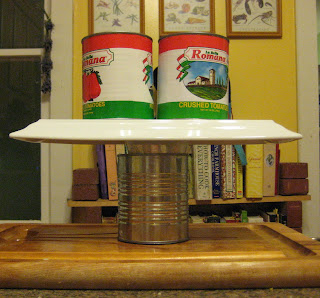

I detached both ends of the can, using one end as a follower and the other end in place, but able to drain. The scheme worked decently, although the cheesecloth snagged on the can and bunched, giving me a less than perfect final shape:


I also made some ricotta from the leftover whey:


Usually, I add some more milk to the whey to increase the yield of the ricotta. I forgot, so only got a scant 1/2 cup - not enough for ravioli, as I was planning. I mixed what I had with some maple syrup until it was smooth, and my son was happy to gobble it up as a make-shift pudding. A lot of the homesteading books talk about giving whey to your kids to drink as a replacement for soda. But unless I trick it out with sugar and flavoring, I doubt my son would go for it. So I'll keep making ricotta, even if the yield is low. Anyway, the cheese has now air dried for two days, and I will wax it this afternoon. After a month or two in my cheese cave (a.k.a the 55 degree laundry room in my basement), I will test it out. I'll make some rosemary crackers for the occasion. It will be just the snack to have prior to facing the March chill and planting those radish seeds!

Saturday, January 30, 2010

Eyesores in the neighbor's yard


We live in a tightly-packed working class neighborhood on the Northwest side of Chicago. The narrow city lots mean we really rub elbows with our neighbors - we can literally reach out and touch our neighbor's house from our kitchen window. I don't kid myself that we live in an aesthetically pleasing environment: this is a tough, urban neighborhood. Lots of fences, more cement than green space, houses in various states of upkeep and the perpetual "city mulch" of newspapers, plastic bottles and other wind-blown trash. But, a girl can fight to make her little piece of this area as productive and attractive as she can. And I have to give it up to my fellow denizens -- even the known gang member houses usually have hanging baskets and some bulbs in the front yard.

Our neighbors to the north are a young family with three kids, who use their outdoor space and garden regularly. They are of the single-plant-surrounded-by-two-square-feet-of-dyed-mulch school of gardening, but I can't begrudge their enthusiasm. Their children are also willing to eat anything I hand them through the cast iron fence that separates our two yards, be it strawberries or raw asparagus.

The neighbors to the south give me reason for garden grievance. They are a polite, elderly couple who keep to themselves. They give a wave and a "God bless you" whenever they see us, but generally stay inside. In the height of summer, the husband will putter around the yard, and he grows one or two tomato plants. Otherwise he lets weeds grow rampant in the yard, organizing them into a semblance of border beds around his yard. Now, I don't mind asiatic dayflowers, but I am tired of ripping out yards of invasive bittersweet nightshade. No matter how much I get out, more always comes through on his side. I have gently offered to help him remove the plants from his side, acknowledging the difficulty of an 80-plus year old person wrestling with the aggressive weed. He demurred: he likes the purple flowers and red berries. He likes nightshade apparently more than trees, since he also cut down a mature flowering tree in his yard and now has a sad, rotting stump near the garage.

Okay. So live and let live. This policy of course didn't stop him from coming into our yard uninvited two seasons ago and mowing down our asparagus bed because "rats might live in there". Grrr. The compost bins bother him for this reason, too. Never mind that I have assured him repeatedly that I only use rodent-proof designs approved for urban use.

Yet this is my major rant about my southern neighbors: the abundance of plastic in the yard. They have plastic poinsettias, lilies and daffodils plunged into the various garden beds to mimic real growth. All seem to have been rescued from artificial funeral wreaths and dollar-store party centerpieces. They are old and shabby, with many "petals" now shredded, yet they persist in the beds, in "bloom" no matter what the season. Last year, the husband hung several plastic Sesame Street characters on their clothesline pole near our fence. Every time we walk by, a fading, sad Cookie Monster swings in forlorn greeting. Now, I could rant about the gang tags on our garage, the sneakers and plastic bags hanging from power lines over our street, but these plastic Sesame Street characters are the things that really get under my skin. If I had more space, I would rip out the roses that currently climb the fence separating our two yards and plant some thick, evergreen shrubs as a living curtain between me and these mangy toys.

I have heard stories of aggressive dogs and the dumping of untold quantities of chemicals by neighbors, so this is a small beef in the scheme of things. But our neighborhood needs less plastic impostors of plants and more real plants. Why not hang a bird feeder instead of junky figurines? Maybe my son and I will build just such a bird feeder for them. Who can resist a gift when offered by a cherubic bird-loving toddler?

Wednesday, January 27, 2010

Mid-winter assessment and identifying a weed


The cold is back in Chicago with a vengeance, but over the weekend we had a bit of a January thaw. The snow that had been hanging around since before Christmas melted away, and I went out to assess the garden. I found my fall-divided Sedum "Autumn Joy" already putting forth new growth.


I also took a long, sad look at my Munstead Lavender. I didn't prune it well this past season and the center is all woody. I am not sure if it is worth trying to salvage.


From what I have read, once the center is woody, the best plan is to grow new plants from cuttings. The center isn't as thick and overgrown as some I've seen, but I plan on starting a few new plants this year. I just went to a propagation workshop that recommended stripping a branch, coating it with rooting hormone and layering it in the soil. I may try that, but someone also recently gave me a package of clear rooting gel. I think this will be a good way for my son to track the progress of the new plants and see how roots form.

Along the side of my house, in a slim cement crack, I found a mystery weed still thriving. It popped up this year, and I wish I knew what it was! It has very sweet purple flowers during the fall. I am sure it is a common urban weed, but I rather like it. It brightens up the harsh cemented-over area.


At first I thought it was creeping charlie, but on closer inspection, the leaves aren't the same.

I am continuously frustrated in my attempts to identify weeds in my yard. This website on Illinois weeds should be helpful, but the search function is difficult and the pictures do not reliably load. This site on weedy wildflowers in Illinois has better pictures and information, but no search function. The one weed book at my library is in black and white and focuses on meadow weeds. What's a girl to do? Maybe the Internet will work its magic and someone clicking through this blog will know what this is.

The one thing I am sure of is that this weed will be listed as a plant that loves barren ground and abandoned industrial wastelands. Whenever I positively identify a weed in my yard, it is always listed as a plant that thrives in horrible, infertile areas. This always punctures any pretensions I have about my little urban plot being some oasis of organic fertility. Oh well, the real weed identification won't begin for a while yet. More snow has fallen, and it feels like January again.

1/28/10 Update....I found the answer to the mystery weed! See comment below!

Monday, January 25, 2010

On frugality


My garden reading (both blog and book) tends towards the rural homesteading variety. I am not raising my own livestock, grinding my own grain or eating solely off of my winter-grown greens. Thus, I tend to think of myself mostly as a homesteading dilettante -- if a home-cooked dinner doesn't come together one night, it ain't like I'm gonna starve! Just dial the phone or head out to the nearest taqueria and my family is fed. This past week has been a lesson to me, that, yes, my family will be fed, but it may not be fed well, and even this will come at a steep price.

Deadlines, emergency meetings, and weekend call schedules have recently conspired to dislodge me from my usual homemaking groove. Thanks to a series of unfortunate scheduling events, for the past two weekends I have been unable to perform the Saturday morning ritual taught to me by my mother. This three-step process involves 1) a careful appraisal of my refrigerator, freezer and pantry (and garden, too, if this was the season); 2) the design of a week's worth of meals, with make-ahead dishes for my late-work nights; and then 3) construction of a shopping list, divided into categories of produce, dairy, meat, staples, etc. Then I embark on my hunting and gathering expeditions -- crossing off items as they are purchased, or modifying the menu if I find a bag of well-priced apples, etc. I have rarely deviated from this ritual since the day I set foot in my first apartment ten years ago. Sure, it's anal-retentive. Yet, it's the only way I know how to put healthy homemade food on the table most nights of the week given the extraordinary demands of a two-career household, especially since both of us have long and often unpredictable hours.

Feminists, start your engines here, and curtly remind me that my partner could do his share of the shopping and cooking. Unfortunately, we have a marriage that does not flourish with 50%-50% division of household chores, since it means that neither person ends up accountable for anything. This has been a hard lesson learned, and we realize that 100%-0% responsibility for all-chores-not-child-related works better for us. Hence I never touch a dirty dish, vacuum or laundry basket; but I do all shopping, cooking and de-cluttering. The magic -- and this I suspect is usually the magic with most negotiations -- is that each of us secretly thinks we got the better end of the deal.

Anyway, this well-calibrated system had a meltdown over the past ten days, leading to no shopping expeditions or even menu designs out of the pantry and fridge storage. I have been shocked by how expensive it has been to eat "cheaply". We weren't going to fancy restaurants -- taco joints and pizza places-- yet expenditures are still more than double my usual grocery bill for the week. We also have not had enough fruits and vegetables and have eaten too much salt and fat, and our guts and mental health are the worse for it. In desperation, I made a run to the nearest chain grocery store - I realized I hadn't been there in probably 6 months. I just "didn't have time" to go to my usual local food purveyors or even Whole Foods (never mind that this would have added but 10 minutes in the car -- when you are in scheduling-crisis mode, you don't make rational decisions). The prices were high, everything looked waxy and unappetizing, and the fish and produce I bought tasted terrible. Also, I realized the terrible reality of shopping at 6 PM on a weeknight rather than 6 AM on a Saturday. The store was packed with tired, hungry shoppers and employees with short tempers. No wonder most people just order Domino's!

Last night found my small family exhausted, hungry and out of appealing options. I fully understand that this is an upper-class dilemma. We had options for food, and I know that many don't. But the options we had at that moment were either expensive, unhealthy or both, and they all required us to leave our house yet again, so there we sat, inert. Finally, the deadlines had been met. This next week promised to be easier -- no dinner meetings, no late-night calls, no extra shifts. But it was 7 PM and I couldn't bear to go to the store, and none of us could stomach the thought of more restaurant food. The cupboard was bare -- even for simple things like pancakes (no flour), rice or pasta. The fridge was a grim wasteland -- 3 jars of kimchi and a big bag of dried out carrots. So, I rallied, and made "Pennies from Heaven", as my husband calls them: I peeled the carrots, cut them into coins, blanched them, then sauteed them in my last scrap of butter, sprinkled with sugar, salt and black pepper. I would have put grated lemon or ginger if I had them. But I didn't. We sat and ate and my toddler was happy. My husband announced it was the best thing he'd eaten in a week. I even had a big pile of peels to tuck into the worm bin. Pennies from heaven, indeed.

Today, I have an unusual day off from work, to compensate for the recent heavy scheduling. I am using the day to shop and stock up. Normally, I avoid stocking up too heavily on pantry staples, mostly because I just have one narrow cupboard set aside for food storage. But I have a big hallway closet, cool and dry. I am buying bulk rice, beans, pasta and flour. I am making chicken stock today with all the scraps I have tucked away in my freezer. I am making my list and checking it twice. And I'll get a big bag of storage carrots to tuck into the bottom of my fridge -- at least this way, there will always be an option before Domino's.

Wednesday, January 20, 2010

Vine love


As an urban gardener, I learned quickly to think vertical. Not only do vines and climbers increase the productivity of a limited space, but they also add new heights of visual interest when a space-and-sun-hogging tree just isn't feasible. All of my favorite garden design books advise the creation of outdoor "rooms", an idea which always seems a little out of reach for my tiny plot. Our whole property, however, is surrounded by a tall cast-iron fence. In the height of summer, when covered with climbing roses and annual vines, the fence becomes a floral wall. If I squinch my eyes enough, my fences of vertical vines give a very private and room-like feel to our yard. Past the grape arbor, along the garage, is a second tiny shaded space. So, my garden rooms make up a horticultural studio apartment, or as a New York real estate broker would spin it, a "junior one bedroom".

I've posted on my two favorite vines before, the cardinal climber and the black-eyed susan vine. They will both be making a repeat appearance in my 2010 garden along with the scarlet runner bean and various morning glories. I have a clematis or two struggling along in various spots, despite suboptimal conditions and neglect on my part. I don't have the heart to rip them out and every year, against all odds, they do put forth some nice blooms. Both the scarlet runner and the cardinal climber are hummingbird friendly, so I'll keep my fingers crossed that we'll get some visitors this year. After watching the recent PBS special on hummingbirds, I was pretty much ready to up and move southward. Yet even if tiny birds do not appear, the vines please tiny humans. My son loved the scarlet runner with its fairy-tale beans. If I have the energy this spring, I plan on trying to make him a little wire structure and plant it with annual vines. Hopefully by the end of the summer will create a quiet green hideout for him.

As for new annual vines for this year, I am going to try Asarina scandens, Vigna caracalla and Passiflora incarnata. I think the V. caracalla and the P. incarnata (Maypop passion fruit) are actually perennials, just treated as annuals here in the northern zones. I may container plant a few and see if I can nurse them along over the winter. After browsing through the online catalog of Summer Hill Seeds, I was so taken with the photos of the Vigna caracalla "Corkscrew vine" that I impulse purchased a package of seeds on the spot. If I can get even just one of those flowers to bloom this year, I will be a satisfied woman: the blossoms are so sculptural, and colored so delicately, I imagine I could spend hours inspecting them. The passion fruit is also a flower-driven purchase. The blossoms of the Maypop look like otherworldly jellyfish -- not unlike something out of Avatar. Apparently, they do fruit, but I suspect they might need a longer, warmer season than we can offer here in Chicago. So, there it is, sucked in by showy flowers. I know I should be moving towards more design sophistication and focusing on foliage and massing, etc. But these two flowers are so breathtaking in pictures that it will be like Christmas if they ever grow in my scrappy little patch of earth. And what is the point of gardening if you can't get giddy over a flower or two? I'll trade a whole swath of healthy hostas for a few moments with the corkscrew blossom.

I've already started the Passiflora, here it sits at a steady 70 degrees above the fridge -- germination is spotty (30% on the package!).

Finally, I am going to put in some Cascade hops along the sunny corner of my hopefully new front porch (that was supposed to have been done already-sigh). Hops is a strong fast-growing vine, yet one that dies back to the ground every season. Oddly, I am not a home-brewer, at least not yet, but I know a few folks who might be interested in making a seasonal IPA with fresh hops. I was reading a few on-line guides to growing hops and ran across a truth that bears repeating to all urban vine lovers. Watch where you plant in regards to overhead wiring. Before you know it, fast-growing vines can wind their way up your overhead power, cable and phone lines. Last summer, I faced a small crop of green beans hanging 15 feet over our backyard. For safety and convenience, this was clearly not ideal. But it did make me wonder...could I train a whole crop along overhead twine? I could have a green-bean roofed patio. Hows that for a room?

Sunday, January 17, 2010

Perennial edibles

My asparagus bed is now heading into its fourth season in my garden, occupying the sunny northwest corner of my backyard. Given the size of my overall property, I rarely get enough spears for more than one meal or a few appetizers. Many spears do not even make it into the house, as they are tender enough to snap off and snack on as I garden. For those used to tough grocery store asparagus, I assure you the raw spears are not stringy at all. The best way to describe the taste is green. And there is little more thrilling to me than seeing the first of the fat spears pushing up through the spring earth.

As I lay out my garden plans for the coming season, I am trying to sort my various endeavors into neat categories like fruit, herbs and annual vegetables. Asparagus, as well well as my rhubarb, defy my easy categorization. I settled on the description of "perennial edibles". Joining this category for 2010 is sorrel and horseradish. Now, I was on the fence about whether to include these last two in the "herb" section, as this is where they end up in the seed catalogs. Since this is a blog for my own writing and record-keeping purposes only, I am including them here. I sincerely doubt -ahem- this will create a raging controversy in cyberspace.

Asparagus, however, is so much more than an edible. After the weeks of harvesting the spears, the plants must be allowed to fern out and make energy for the next season. The tall, delicate ferns are gorgeous, enough to recommend them as ornamentals, even if asparagus isn't your favorite vegetable. I have read they make a decent trellis for vining flowers, so this year I am planting sweet peas among them. Other than a thick autumn layer of rich compost and manure, the plants ask little more than to be left alone after the spring season. Be careful! If you cut back the ferns, more spears will grow, sapping the overall health of the plant.

I can't say that I am as enamored of my rhubarb plant. I had three originally, but two didn't survive past the first season. The untimely demise was probably for the best, since it is a space hog in a small garden. Nor am I swimming in good recipes for rhubarb. A few pies and cobblers, maybe a batch of preserves, and I'm done. I have a clipped-out recipe for a rhubarb-lentil stew that I eye every season, but it sounds so horribly nutritious and earnest that I have never worked up the excitement to make it. I do appreciate my one delicious cobbler that I make, and the pale red stems are beautiful. In larger gardens, I have seen rhubarb plants used to gorgeous effect as single specimens, and they seem to tolerate partial shade.

I am planting sorrel this season because, contrary to the rhubarb, I have several recipes that I am dying to try that feature sorrel. I have looked in vain for it in the markets of the Chicagoland area, so it must be planted. I refuse to go another year without tasting sorrel soup or lemon-sorrel mousse. An added benefit of planting sorrel is that it appears in early spring, thus giving culinary variety to a season typically dominated at our home by radishes and chives.

Finally, as I have posted before, I am putting in horseradish. Yes, it can be invasive. Yes, like rhubarb, I suspect it is a space-hog in a small garden. And yes, it has even more limited uses than rhubarb. The above jar has lasted me quite a while. What is compelling me to plant this? I believe it is the spirit of the folks who used to occupy this formerly "Bohemian" neighborhood. It will make easier my hunt for the components of the Seder plate. I may even try to make horseradish cheese, which is just that, cheese with some grated horseradish stirred into the curd. I always bought this from the Pennsylvania Dutch folks at the Union Square Farmers Marker in New York City, and it tastes great with beer. I have read horseradish makes a good companion planting for potatoes. Since I am trying some fingerling potatoes this season, I will plant them close together. My main annoyance is that you can't just buy one or two roots. All the catalogs sell at least five. Who is eating this much horseradish?

Thursday, January 14, 2010

Backyard fruit-o-rama


If you are looking to impress friends and relatives with your culinary green thumb, fruit is the way to go. Last summer, people who yawned at my piles of green beans and eggplants would invariably perk up at the sight of strawberries. "You GREW those?" they would ask, as if somehow this required a super-secret level of gardening prowess. Folks who gave not a second glance at my beautiful herb bed would rush over to the grape arbor and sigh with delight. This is all particularly amusing since these fruits are actually some of the easier things to grow in my garden.

I am a recent convert to growing fruit in a small urban area. Initially, it was hard for me to banish visions of rolling orchards, replete with hundreds of neatly planted trees. My garden can't even support one full-size tree, at least not without sacrificing the entire area to eventual shade. Even my research into smaller-scale backyard fruit growing intimidated me -- check out this local guy on the Midwest Fruit Explorers website!

An impulse purchase of a Concord grapevine started me off on my fruit forays, and the grapes were followed last year by strawberries and a fig tree. This year, I'm widening my scope even further. I have a sunny patio that my husband does not want me to remove, so I figure it is a great spot to launch some container-grown fruit experiments. Even if you have no yard and just a balcony, you can try some of these. And you'll get nothing but honor and admiration from your non-gardening friends -- the type of glory you will never receive for producing a cabbage, no matter how perfectly formed.

So, here are the 2010 fruit plans:

Tried and True

Strawberries (alpine and Ozark Beauty) -Last year was my first season growing strawberries, and they were a runaway hit. I am partial to the alpine strawberries, though the yield is so low, it would take a field to produce a pie. The Ozark Beauties were great, only problem being that a few weeks of neglect led to a lot of runners everywhere. Last year was my first summer, so we didn't get a full harvest in the interest of pinching back flowers to make the plants stronger. Even so, we did get a fall flush that was delicious. We'll see if they successfully overwinter -- I did mulch generously.

Concord Grapes - I love these grapes -- they are tasty in preserves and the leaves are beautiful, especially as they fade to an autumn gold. My only mistake was to plant them next to a flimsy plastic arbor. This is a seriously strong vine. Build a good arbor.

Fig - Carla Emery's quirky and essential Encyclopedia of Country Living gave me the inspiration to try a potted fig, and I posted in October about my container-grown fig tree. Admittedly, the fig had a tough first summer. I blame the lack of ripe fruit on the rain and cold -- from what I've read, figs this far north are a crap shoot. You'll get fruit, but only in warm, long summers will it actually ripen. The tree is overwintering in the unheated area of my basement, and receiving a bare minimum of water. I will haul it out of hibernation as the weather warms.


New experiments:

Blueberries - I'm from New Jersey, land of acid soil. Our childhood house had beautiful azaleas and rhododendrons as foundation plantings. Blueberries were easily found on hikes along the Appalachian trail. Here, with Chicago's Midwest alkaline soil, I can either amend aggressively or container-grow. I've opted for three different varieties, billed as "patio plantings". They come with some kind of special acidifier supplement I am supposed to add to the container. Any fruit will be better than the mealy marbles sold at the grocery store.

Cherries - I'm going for a dwarf tree billed as "small but mighty"... I will likely plant this in the ground, although it can also be a "patio plant".

Kiwi -I needed a new vining plant along my north fence, so I thought I'd try a hardy kiwi. I found one billed as self-pollinating. I wish I could have tasted a hardy kiwi before actually planting it...but I like regular ones, so hopefully they will come close. One alarm bell....my research revealed that the plants have a "catnip-like scent" - will this mean I will have more alley cats in my yard? At least that will keep away the rats.

Peach - Okay, this is my most embarrassing one -because I fell for the gimmicky "patio tree" that looks like one long skinny branch sticking out of a pot. I always stare at these in the catalogs...they look so wrong, yet I have been dying to try one. The price scares me...not sure I buy 25 bucks worth of peaches in a given season.

If I had the space, I would do raspberries, a quince tree and hazelnuts. But I will settle for (in a few years) a ripe fig and some kiwis...if the alley cats don't get them first.