Wednesday, May 5, 2010

Lest I romanticize the homegrown life....

Cinco de Mayo seemed like an excellent day to slice open the Monterrey Jack cheese that I made in January. I planned to pick up some masa at the local Mexican store, entertaining a rosy vision of pressing my own tortillas and toasting up homemade quesadillas. I sliced into the red wax and all looked well: a little wetter and crumblier than I had expected, closer to feta than cheddar in texture. But one bite was all it took to erase any quesadilla dreams: a bit sour, not salty enough and a weird chalky aftertaste. There's the rub with hard cheesemaking: you wait months only to find out something went wrong in the process. Who knows what it was? The milk was from the grocery store, so its not like my ingredients were prime. Maybe too much rennet, too little salt, excessive moisture? My best guess is moisture, especially since I rigged up a homemade press that probably didn't deliver the necessary pounds per square inch.

To cheer myself up, I decided to break into the refrigerator rhubarb pickles that I made over the weekend. The flavor was okay, a bit too vinegary for my taste and the chili heat was weak. But the texture! Uggh! The stalk was so stringy, I could barely bite through it. Note to self: next time, rhubarb preserves need to be chopped up, or else the stalks peeled. So there I sat with sour cheese and stringy pickles, generally glum about my dilettante efforts to decommercialize my kitchen. Kraft and Vlasic are leagues ahead of me.

I should be grateful I am a dilettante -- if we were truly living off the land, we'd be facing a grim dinner tonight. Fortunately, I am just dabbling and there is no wolf at the door. I can chuck the nasty stuff and pull out some spaghetti and frozen tomato sauce. In the future, I'm sticking to my tried-and-true pickles....cauliflower, Brussels sprouts, dilly beans and watermelon rind. As for the cheese, it's probably best to dabble in the soft stuff. I can make a good ricotta, and I don't have to wait four months for a taste. So it is that, or buy a real cheese press....tempting as always to go for the hardware. But I should probably avoid the overhead if I don't have a reliable source of good milk. All the more reason to convince my husband we need a goat...

Tuesday, May 4, 2010

Out of the garden and into the wok


The garden greens are coming fast and furious these days. From young kale to crinkly spinach, I am serving up this leafy bounty before the cool Spring weather is replaced with bolt-inducing heat. Many of the greens, specifically the mizuna, are doing well with "cut and come again" treatment (hence the shaggy look in the photo). Yet, most plants will have to be yanked and eaten in their entirety prior to Memorial Day. They are occupying space reserved for my warm-weather seedlings: the peppers and tomatoes are rapidly outgrowing their pots! I console myself that soon enough we will be facing the prospect of Autumn weather and, once again, my 'bright lights' Swiss chard can grace the garden with its perkily colored stems.

This year, the winner of the bunch in terms of both production and flavor has been the mizuna. On the peppery scale, it is closer to mustard than spinach, and the young leaves can sub in for arugula in most salads. Our favorite way to eat mizuna is stir-fry. The preparation is so simple that it barely qualifies as a recipe. It is more a general approach, suitable for everything from spinach to broccoli: Heat up a wok nice and hot, saute a few minced cloves of garlic in some oil and then toss in the mizuna along with a good shake of oyster sauce. After a few minutes, the greens will be wilted but bright. Serve it forth to much acclaim, even from hardened greens-haters. The mizuna gives a nice bitter counterpoint to the salty-sweet oyster sauce. As with most cooked greens, it is shocking how small they cook down. I filled a large salad bowl with mizuna last night, and had barely enough stir-fry to fill a salad plate.


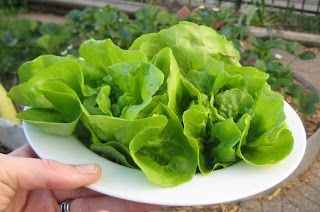
On the lettuce front, we are enjoying the mature heads of the variety "tom thumb". If you really want to class it up, each precious head can be served as an individual salad. Just drizzle them with a nice vinaigrette, and you're done. At our house, butterhead lettuce leaves usually act as edible serving utensils for a spicy ginger-pork mixture. The cool, bland leaves serve as tiny cups for a few tablespoons of hot and heavily-flavored stir-fry. The juxtaposition between the cool and the hot is heaven in the mouth. The original recipe calls for cilantro, which my husband hates. In the spring, we add mint instead and in the summer, Thai basil. These lettuce cups are easy and addictive: I have tried a lot of recipes in my lifetime and this one is a keeper. Print it out and it will serve you well for years. I am looking forward to my first delivery of CSA pork this month, so that this favorite meal can be truly local!

Sunday, May 2, 2010

Edible flowers


Edible flowers always seem to me more of an eye-pleaser than a palate-pleaser -- while a few yellow or purple blooms can boost the visuals of a salad, I rarely find that they boost the flavor. After the "Wow! I am eating a flower" moment, I don't need to go back for another taste. A garnish of flowers is a good way to show off your chef street cred to impressionable guests. Sadly, after the oohs and aahs, usually the blooms are politely pushed to the side of the plate. Nor do I blame these diners. The candied violets I made a few nights ago -- jewels though they were -- tasted, well, sugary. Ho-hum.


In my experience, the exception to the underwhelming taste of edible flowers is the humble chive blossom. Though billed in many a garden book as imparting a "mild onion flavor" to dishes, I find the taste more powerful, closer to that of raw white onion. This strong, lingering flavor is especially prominent when still in half-bud, the tiny florets just emerging. Added to omelets or pasta, the blossoms can serve the same role as chive leaves, but with a lovely purple tint.


Many a gardening expert attests to to "spicy" punch of nasturtium flowers, which I will taste soon enough thanks to the seed GROW project. I tried to resist planting the nasturtium seed until all danger of frost had passed. But I just had so very many seeds, and with so much room for error, I had to push the limits of weather. After an overnight soak, I planted some seeds three weeks ago, and only one came up. Replacements are going into the ground this week. I was tempted to pluck one of the first tender leaves from the seedling for a quick taste, but I resisted. Soon enough I will have leaves and flowers by the bowlful. Let's hope that's a good thing for both the eye and the palate!

"I'm growing Nasturtium "Spitfire" for the GROW project. Thanks to Renee's Garden for the seeds.

Saturday, May 1, 2010

Spring preserves


The backyard homestead has become more lush in the past week. Every day, there is the possibility of one, or even two, homegrown ingredients on the dinner table. Last night, we had mizuna in our stir fry. Tonight, freshly picked radishes and rhubarb will grace our May Day table. The radishes will be served simply, with homemade bread, salt and butter. The rhubarb will become a small dish of cobbler -- oh, if only the strawberries were a little further along! After dicing up the rhubarb for dessert, I found I had some extra stalks. Thus, I launched into my first garden preserves of 2010: rhubarb pickles.


Now, at first I had planned to make rhubarb pickles with this recipe. Then I noticed that it called for sherry vinegar and grenadine. Now, I am not above purchasing specialty ingredients....my overflowing pantry attests to my habit of buying all too many one-use bottles for my various recipe experiments. I could probably use the sherry vinegar again for some Spanish tapas extravaganza, but the grenadine distressed me. I don't really use it in cocktails, and the most readily accessible brand seems to be little more than red-colored high fructose corn syrup.

Never one to abandon a recipe, I started researching various homemade substitutions, like reducing pomegranate juice with sugar. At this point, however, I was going to be spending more time making the grenadine than I would spend making the actual pickles. I also don't have pomegranate juice sitting around the house, so this would mean a car trip, more grocery money, etc. It all seemed too tiresome and expensive, not to mention against the pioneer ethos of making do with what ya' got. It was time for a new recipe.

Mother Earth news to the rescue! I found an interesting recipe, calling for ingredients I had lying about. This also gave me a use for the last of my homegrown dried chili peppers. Now my jars are cooling. I am tempted to dig right in, but I know they will taste better in a few days, so I will eat a radish and wait patiently. This is a refrigerator pickle recipe, as the hot-water canning process would soften the stalks to a mushy consistency. It makes sense to focus on quicker preservation processes in the spring and summer: the coming abundance means there is no need to stretch the vegetables into the dark of winter. Gather ye rhubarb while ye may, and leave the late-summer cucumbers to the more shelf-stable pickling methods.

Thursday, April 29, 2010

Candied violets


I have to remind myself next year to not schedule so many business trips in the tender weeks of late Spring. While in Vancouver, I missed the sprouting of the shallots, the first blossom of the Early Girl tomato, and the initial burst of intense forget-me-not blue now edging my front bed. I missed the unveiling of the 2010 One Seed Chicago plant: bee balm (I voted for it!). I also missed my husband's birthday, and while he is not one for big occasions, it is sad to pass a milestone alone in the house while son and wife are off eating halibut.

To make it up to him, I have constructed a mile-high chocolate cake garnished with candied violets from our backyard. I couldn't resist a homegrown garnish, even though the cake is replete with exotic ingredients. I had never candied violets before, and learned some lessons in the approach. The general idea is simple: coat the flowers in egg white, dust with sugar and let dry. Most recipes advise painting the egg white on with a paintbrush. I was put off by the preciousness of the individual petal painting, and was glad when I found a recipe that instructed the cook to swirl long-stemmed violets in frothy egg whites, "roll" in sugar, and dry them. Unfortunately, this method gave me a series of gloopy blossoms, barely recognizable under a thick lava of wet sugar.


When Martha Stewart tells me to do it her way, I should listen. It always works. So, I raided my son's craft box for a clean paintbrush and painted each delicate petal. I did ignore the call for superfine sugar. Regular granulated looked just fine. I organized the violets on waxed paper, snipping each stem off, and dried them in a warm oven for a few hours. Thanks to the egg white, many of the violets stuck to the paper and were too delicate to remove without incurring serious structural damage. After all of that work, I have six violets to show for it. This is all further evidence that I was not made to be a pastry chef. So I will use what I have and break out the grill. For though violet petals may be delicate, big hunks of marinated meat are not, and this is what the birthday boy wants for dinner.

Friday, April 23, 2010

First fruits


The nights are still cool but my garden is full of sweet promise. The first of the fruits are starting to set: the strawberries, the grapes, the figs. Blueberry blossoms hang like porcelain bells from their thin branches. I think these are two year old plants, so I am advised by various authorities to not let them bear fruit. I assume this is in the interest of diverting energy solely to plant growth. I will probably let the berries mature on one of my three bushes, to give my son a taste and also in the name of science. I will be interested to see if next year there is any difference in the size and production of the plants.

Alpine strawberries

Ozark beauty strawberry

Kadota fig

Concord grape

The dessert table beckons, if my greedy family lets any fruit actually make it in the door. Usually the strawberries are gobbled while crouching in the garden, the morning sun glinting off the dew. I have more hope for the grapes; the texture is a little slimy right off the vine, so this late harvest will likely make it to the jam pot. As for the figs, I have a vision of home-cured prosciutto draped over a homegrown Kadota fig....a little taste of the Tuscan countryside right here on the west side of Chi-town. I will need a long, hot summer to see any ripe figs, and I am keeping my fingers crossed. Either way, I will have beautiful fig leaves to decorate my cheese plates and the romance of a potted fruit tree in an otherwise concrete-laden corner of my urban yard.

Wednesday, April 21, 2010

Spring seedling protection

After the warm spell a few weeks back, Nature has emphatically reminded us that frost will threaten Chicago well into May. Blankets hopefully stowed away in closets have been pulled back out and spread once again across the bed. I recycled my milk gallon "cloches" during the early 80 degree weather, only to spend a hasty evening with a box cutter this past weekend, fashioning more.

This is not to say the garden has suffered. The peas, spinach and other cold-weather greens (mizuna, mustard, kale, chard) are thriving, but not yet at harvest stage. The herb garden is almost lush, and I can add tarragon, chives, thyme and oregano to my dinners with renewed culinary abandon. The first flush of asparagus is over, and I am waiting for another round of spears. The first of the strawberries are poking out of faded blossoms, and the rhubarb is looking almost prehistoric in size. But how have some of my other spring seedlings fared, those both naked and protected? Here is a photo update of my various experiments.

1. Cold frame lettuce: I sowed lettuce "tom thumb" on March 6th in both the cold frame and in a bed nearby, unprotected. After 6 weeks, there is a marked difference in the size of the seedlings - I didn't have a ruler, so I am using my size-11 foot for reference.


We have already thinned out the cold frame lettuce above for an early spring salad.


This unprotected lettuce has barely passed "microgreen" stage.

2. Store-bought vs DIY wall-o-water for tomatoes: As I posted a few weeks back, I set out two very small sweet 100 seedlings, with barely one set of true leaves. One went into a 2L pop-bottle fort and the other into a purchased Burpee brand wall-o-water. It pains my DIY aesthetic to report this, but the wall-o-water is vastly superior (and I even cheated and gave the DIY seedling a slightly sunnier spot!).


The amusing lesson in all of this, however, is that the most developed tomato seedling is the one I have left out to the elements:


Of course, this is an Early Girl, not a Sweet 100, so maybe she is just living up to her name. Her foliage is denser, her stems thicker. Lesson: if I am that committed to having home-grown tomatoes on the 4th of July table, perhaps time would be better spent growing earlier varieties, rather than coaxing mid-to-late season varieties into early harvests.

I have also noticed that my almost completely neglected wintersown tomatoes are rapidly catching up to my coddled sweet 100 seedlings. They too have thicker stems and denser foliage. Maybe all the indoor-start-hand-wringing is for nothing, and I should wintersow everything and be done with it. This is probably the sensible plan, and one that makes sense given my limited time. But then what would I fuss over in the waning weeks of winter? What would I do if I had no seedlings to run out and cover with homemade cloches? Why garden if you don't want to take pains, foolish though they may be?