Friday, November 13, 2009

Worms!

After many years of talking myself out of vermiculture, I took the plunge and ordered a pound of red wrigglers for winter composting. I set the worms in a thick plastic bin I found for $1.99 at a local store. I drilled a few holes, added some wet newspaper and voila!

I was underwhelmed by the amount of worms when they arrived, but according to the seller, worms can lose 70% of their body water during shipping. I gave them a good drink in their bedding, and hopefully they will plump up.

I have already identified two challenges of worm composting for my family. First, my curious toddler wants to see the worms every few minutes. Clearly, these critters want to be snuggled down deep in their bedding, and my little guy wants to have them sit at the breakfast table with him. This is likely a function of natural curiosity and our pet-deprived home. These are the first non-human creatures we have (intentionally) hosted in our home. Fortunately, feeding the worms is almost as good as seeing them, so my son's job will be to carefully place scraps in the bin. If it takes him an hour, so be it. The second issue is the sheer amount of vegetable matter our family of three produces. Websites give various ratios for amount of scraps per square foot or per pound of worms, but the basic message is not to overwhelm the worms, especially not in new bins. Last night, as I stared at the mountain of compostables from our vegetable pad thai and fruit salad dinner, I realized that unless I dedicated some serious square footage to vermiculture, I was still going to be making the cold trip out to our regular composter.

We'll see what comes of this experiment, but I am embarrassed at my years of delay after seeing the low cost and ease of this project. If anything, it has inspired me to look at some other simple gardening projects I have been eying with trepidation for years. The worm bin has let loose the flood gates, and this winter, my son and I are going to have a new basement project: building cold frames for an early spring harvest!

Thursday, November 12, 2009

Living Seasonally


It seems like cruel and unusual punishment towards fellow gardeners to enthusiastically review an out-of-print book, but I cannot help myself. A kindred spirit with better Internet shopping skills found a used copy of Living Seasonally by Joe Eck and Wayne Winterrowd. He generously loaned it to me, and I have been enthralled by their writing and their vegetable gardening ideas for the past week.

The two men have a large property in rural Vermont, on which they raise almost everything they eat, including veal and poultry. While this is clearly beyond the reach of a novice urban gardener with an --ahem -- smaller plot of land, so many of their ideas translate well to any edible garden. Most of their growing tips and enthusiastic endorsements of certain plants will be tested in my own garden in the months and years to come. The two men are at once enormously sensible and deliciously romantic: how can I resist Egyptian tree onions or home-forced endive after reading of their experience?

I most enjoyed their discussion of the tension between sustainable living and seasonal eating. Anyone with homesteading ambitions, be they urban fantasies or rural realities, looks forward to "Independence Day": the day when everything that you put in your mouth --from sunrise to sunset-- has been produced from your own land. In the drive towards that goal, there is always the troublesome possibility that seasonal eating will go by the wayside. The two men discuss how one year they cut, blanched, and froze twenty or so heads of cauliflower to stuff their freezer full for the winter. Did that enhance the self-sustainability of their enterprise? Perhaps. But frozen cauliflower is frozen cauliflower. Eating this product in late March is not strictly "seasonal" living. I had the same feeling as I canned my tenth jar of grape jam this fall. We are a family who at most goes through two or three jars of preserves a year. Were my jars of jam an act of living off the grid or just useless overproduction?

The two men eventually decided that there would be no freezing of produce, and that preserves (i.e. oil packed tomatoes) would be made in the reasonable quantity that would be consumed the course of a season. While this might mean a few duller days in late winter, they felt that it enhanced the small moments of celebration when, for example, two perfect weeks of cauliflower were available from the garden. For that time, and only that time, they would feast, and then be sated with their fill of that vegetable.

This whole idea gets back to my concerns about overproduction. I am so used to the idea of a "good" vegetable garden being one in which there is row upon orderly row of heavily producing plants. But we are three people only! We just don't need a whole row of zucchini. If I can mentally break out of the row mentality, I still struggle with the need for multiple specimens. For example, I planted three Brussels sprout plants this year -- what a folly! The plants thrived, and put forth a huge amount of sprouts. We happily ate them for a few meals, yet a few did suffice, since none of us are true aficionados. Then I was stuck with quarts of sprouts in peak form. I gave some away, and pickled others in a spurt of ridiculous thriftiness. One jar of pickled Brussels sprouts is interesting. Five become a bit of a chore to slog through. I am not growing this produce to survive the winter. I can have my sprout feast one weekend and be done with it. I can revel in the luxury of a small celebration, versus the grim mentality of sustenance.

As winter closes in, and visions of 2010 seed catalogs dance in my head, I am meditating on my goal of producing delicious, unique seasonal tastes. I want my family to have fleeting celebrations, all the more poignant for their short duration. The one we have already effectively established is breakfast radishes. I always plant a row as soon as the soil can be worked, and for a brief two week period, we load baguette slices with radishes, butter and salt. It is our harbinger of spring and we devour our treat, but never try to extend the experience with a second planting of radish seed. Eck and Winterrowd have only steeled my resolve in this matter. Note to self: reread in the spring, right before I look at my packet of radish seed and decide, "lets just plant all of it -- I have a pickle recipe, somewhere".

Wednesday, November 11, 2009

44 days

I mentioned in my first post that I was testing two recipes for a French cordial called Liqueur 44. The "44" refers to the number of coffee beans and sugar cubes that are added to a a quart of vodka or rum, along with an orange. It also refers to the number of days that the concoction should sit and infuse prior to sampling. So, forty four days have past, and my two brews have been decanted and strained into decorative bottles.

Lest you think I have hopped on the trendy train with home-infused cocktails, this is a traditional European recipe. And while food magazines like to present cordial-crafting as some new idea originating in the far reaches of Brooklyn, it is a time-honored peasant tradition (see the first post of this blog). I will admit this is my first foray into crafting an aperitif with ingredients that do not originate from my garden or a local source. Having just nipped at the results, I can't say I am persuaded to abandon my favored recipes for Thyme Liqueur and Quince Eau-de-Vie. Is it terroir? Likely not. These recipes are just more earthy and more interesting than the flavors of of Liqueur 44. Liqueur 44 is jazzed-up Grand Marnier.

The lighter colored bottle is from a recipe from Saveur. This recipe is the more straightforward of the two -- rum, orange, coffee and sugar. The darker bottle is from Susan Hermann Loomis' essential French Farmhouse Cookbook. It is vodka-based, and adds a vanilla bean and a peeled banana to the infusion. Both are a little cloying, as is store-bought Grand Marnier, if I must be honest. If I make it again, I will cut the sugar. There is not a pronounced coffee flavor in either, but there is indeed something taming the citrus notes in both. If I didn't know it was coffee, I would have guessed chocolate. Loomis' has an additional odd but not unwelcome undertone -- funky, overripe -- probably from the banana that slowly blackened in the vodka over the past month. I don't taste the vanilla bean at all.

I'll give the Saveur bottle away as a holiday gift - it is pleasant, beautiful and likely more welcome than another tin of cookies. Loomis' recipe will stay in my cupboard -by Thanksgiving or Christmas, maybe the funky character will be more prominent. My quince liqueur is still "working" as they say, and this is the recipe I would encourage you to try. Your guests can taste orange flavor anywhere, but quince flavor --pineapple and roses? lets just say quincey-ness-- is special. This drink is called a ratafia, an after-dinner drink, which according to Loomis, comes from the Roman tradition of ending a business deal with a drink -- rata fiat, "deal concluded". I'm not sure how many business deals I will seal with this drink, but many a cheery holiday celebration will be the more so for concluding with it.

Quince Liqueur

2 quinces, grated (including peels and seeds)
1 cup sugar
2 cups white rum

1. Put all ingredients in a jar, close tight and shake hard. Place in a cool, dark place.

2. Shake the jar every few days for five or six weeks. Strain into a bottle and discard the solids. Tastes better after several months of storage.

Sunday, November 8, 2009

Kimchi festival


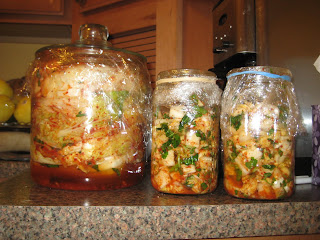
Kimchi, the ubiquitous and varied pickle of Korea, is a classic seasonal dish. From what I have heard and read, November is the time that home cooks prepare the large vats of the pickle that will sustain their families' palates throughout the coming year. As a cook, I am a newcomer to the world of kimchi, having mostly dabbled in cabbages and radishes, although there seems to be a recipe for almost any vegetable one can grow or forage. No matter what the item being pickled, or the level of seasoning, kimchi is invariably a revelation of bright, pungent flavors. For me, it is an effervescent reminder that seasonal, local eating need not mean a dull experience.

All too often, I am put off by the earnestness of the "local eating" movement, especially regarding salt and spices. I am weary of the food writers who, having "discovered" seasonal produce, instruct cooks and eaters alike to honor the beauty of the vegetable by serving it lightly steamed on a plate with the barest of seasoning. Does this approach make the preparation and consumption of the produce any more virtuous or "authentic"? Several years ago, I pored over a found copy of Living the Good Life by the proto-back-to-the-landers Helen and Scott Nearing. While I found their life and philosophy thrilling, I did sigh at the scenes of their dinners. Who among us really wants to sit around with earnest locovores eating unseasoned lettuce from a wooden bowl and extolling the inherent flavors of the leaves? When my husband and I went to Chez Panisse for the first time several years ago, we looked about at our fellow diners thrilling to the "natural" flavor of the beans and squash and began to think that maybe the emperor had no clothes. We were paying over hundred bucks for what was fundamentally under-seasoned but excellent garden produce.

Enter kimchi -- a firm rebuke to any under-seasoned earnestness. Today I made three types, from the article recently published in Saveur ( http://www.saveur.com/article/Kitchen/The-Art-of-Kimchi ). Yesterday, we spent a long morning at the local Korean mecca, Super-H Mart, finding salted shrimp and the right type of radish. It can be a little daunting to look at 10 pounds of cabbage and radishes and realize that I am but a dilettante in this culinary world of pickling --some families have entire refrigerators just to store their kimchi. Of course, I do not serve it at every meal. I have a half-cup or so left of this last year's batch, which I will be stir-frying with shiitakes and slivers of beef for dinner tonight. That is a stand-by meal for us, as are the bright little Korean vegetable pancakes bursting with kimchi that have entirely replaced German potato pancakes in our family (sorry, Mom). Finally, while this may not be "authentic", once you replace dill pickles with kimchi on your hamburgers, you will never look back.

I do appreciate that Saveur took the time to write a long, passionate article about the preparation of this traditional dish. It did cause a cringe-inducing moment for me though, with its quick mention of North Korea and the challenges of finding places to sample the traditional pickle of that region. Food writing can often ignore the political reality of food preparation, and the human toll of starvation and famine. One need to look no further than the horrifying story recently featured in The New Yorker (http://www.newyorker.com/reporting/2009/11/02/091102fa_fact_demick ) to know that for many people access to even a daily staple like kimchi is a right no longer afforded by the current dictatorship. As I taste the product of my morning's efforts, I am sobered by the memory of my reading. The flavor is pungent, and there is a sharp swallow of grief to chase it down.

Thursday, November 5, 2009

Strawberries to bed

I woke up this morning to find my raised beds heaved out of place by the overnight cold. One side of the strawberry bed had burst open -- the victim of a curious toddler having removed some of the reinforcing anchors. I had been waiting to mulch my strawberries. All my references had advised to mulch only after several frosts. But, I figured if it was cold enough to make the soil in my bed expand this forcefully, I should mulch now. I don't want my strawberry crowns to be damaged or heaved out of place. So, after a rib-sticking breakfast, my toddler son and I went out to face the 6 am cold with a pile of newspapers, and we layered them around the plants. Then, we spread a good 4 inches of shredded wood on top.

The traditional mulch for strawberries is barley straw, which I am sure is more picturesque than the newspapers and wood I used. Straw mulch was difficult for me to find, and I don't have a pick-up for transporting a big load anyway, so the bags of organic shredded wood from a local nursery were my compromise. I saw last season that the North Park Nature Village offers straw mulch for the taking. I worried that this free straw would bring seeds of the North Park prairie plants along with it, and I don't want troublesome weeds in my beds. Apparently the city offers free mulch as well -- from chipped trees -- but you have to take a lot, and some folks have reported insect infestations following its use. Strawberry care sources also suggest using leaves as mulch or just newspapers, but I have tried both in other areas of the garden and they blow away. And the newspapers look terrible -- soggy and depressing.

I have been surprised by how engaged my son has been in the care of the late fall garden. I thought he would only want to participate when big vegetables were growing and the soil was squishy and earthworms abounded. Indeed, whenever I see discussions of children's gardening -- Joe Eck being the one exception--, there is focus on rapid production of showy plants or easily harvested vegetables. But my son has enjoyed composting debris, layering mulches, and planting bulbs. This is a reminder to me that children too can enjoy chores and the excitement of planning for another season. If we only offer them radishes and sunflowers in "children's gardens", then how will they ever learn the peace of a spent garden, well-tended, or the subtle pleasure of a cold morning and sweet-smelling mulch? We worked together to spread a satisfyingly large pile of mulch around the bed, and I watched as he fit the rhythm of gardening into his own toddler life: "Good night, strawberries! Go to bed!" he chirped as he patted down the wood. "Don't let the bedbugs bite!".

Tuesday, November 3, 2009

Sedum

My fall garden is not much to look at: my annuals are all gone, and most of my perennials peak late spring to mid-summer. The bare bones are tantalizing for me: I mentally fill in every corner with my new projects for next year, or old friends returned. In a larger garden, one can plan the beds so that there is always some kind of flowering or botanical interest occurring at a given time. To do so in a garden my size, I would either need to relinquish my vegetable real estate, or have one specimen for each time of year. So, my garden peaks over a two month period, then the late summer vegetables take over. The one thing of beauty right now, beside the fading grape vines and peony leaves, are my sedum.

There are two types of sedum that I am familiar with, the tall perennial and the creeping ground cover, Sedum spectabile and Sedum spurium respectively. Both are in my garden: the S. spurium, or two-row stonecrop, flourishes in a moist, neglected patch of earth bordering the north side of my porch. The tall sedum, or showy stonecrop, have a lovely mounded habit. A big round specimen anchors the end of one of my beds. The flowers mature just as all my other flowers fade, and I'm told they are a favorite of butterflies and bees. The sedum "Autumn Joy" (incidentally a possible cross between S. spectibile and another species S. telephium) has pink to maroon flowers that my son calls "flower broccoli", an apt description. The foliage is green and fleshy, with real dimension, like a succulent. The greenery is a presence from spring to early winter. Indeed, sedum is most often cited in my gardening books as an "excellent backdrop" to flowering summer plants.

If the offerings at Home Depot and Lowe's are any indication, it must be a popular plant, and no wonder: as long as it is in full sun, it seems to thrive on neglect and average soil. Sometimes I feel a twinge of shame of loving something already popular...it seems cooler to only grow hellebores, or other less mainstream plants. But the sedum is indeed my autumn joy, and it will always have a place in my beds.

Saturday, October 31, 2009

Halloween feast


I opened the paper today to the inevitable onslaught of Halloween pumpkin recipes from the classic (pies) to the modern (martinis). I actually don't like many dishes made with pumpkin outside of the usual sweet treats like pies and spice bread, and even then once-a-year is just fine. I favor butternut and kabocha if I'm going to cook with winter squash. For me, they have more flavor and stand up better to aggressive spicing. My friend and I just made a pumpkin layer cake, and the recipe substituted Chinese five-spice for the tradition cinnamon, clove and ginger. The five-spice gave a new dimension to the cake, verging on the savory. I will repeat this substitution with my Thanksgiving pie.

Winter squash is a challenge for the urban gardener: it takes up a lot of space and requires careful watering. Every attempt I have made has ended up like a scene out of some horrible eco-hipster Little Shop of Horrors: the vines grew everywhere, fruiting minimally but invading every corner of the garden, rooting at will and even growing into the siding of the garage. I have seen pictures and read descriptions of growing the squashes vertically, and supporting the heavy growing fruit with netting or even re-purposed pantyhose. This seems a little much for my low-maintenance style of gardening and I suspect even then it is gardener-versus-vine for most of the summer. Fortunately, while we don't have a farmers market in our immediate neighborhood, we do have a family farm truck that shows up once a week from Michigan. This time of year, the pick-up is weighed down with piles of winter squashes. For a dollar, I can pay the farmer directly for a nice, heavy squash and thus avoid the summer nightmare of hacking back insidious squash vines like an Amazonian explorer.

Here is my favorite dish with winter squash, and one that is a real crowd-pleaser. I assume my readers are experienced cooks, so I have not elaborated on the exact process of how to fill the ravioli. I also am using my main concession to the time constraints of my life: wonton skins from the market instead of rolling my own pasta dough. I own a pasta roller, and do make my own pasta once in a while, but I admit that I actually like this recipe better with wonton skins. The filling is so rich and heavy, that the ethereal wrapper seems more appropriate. The pale white eggless dough also shows off the beautiful orange-brown color of the filling.

BUTTERNUT SQUASH RAVIOLI

1 butternut squash
1 tablespoon coriander
1 tablespoon oregano
large pinch fennel seed
large pinch crushed red pepper flakes
1 teaspoon salt
1 teaspoon ground black pepper
2 cloves of garlic, minced or garlic-pressed
1 tablespoon olive oil
1 egg yolk
1/2 cup grated Parmigianno cheese
Wonton skins
4 tablespoons butter
8 sage leaves, torn into pieces

1. Preheat oven to 400. Cut squash lengthwise into 6 skinny wedges, and scoop out seeds. Do not peel.

2. Mash the spices, garlic and oil together in a bowl to make a coarse paste. Rub all over the squash wedges. Place on a baking sheet skin side down and bake until soft, about 45 minutes. Let cool.

3. Scrape out flesh from peel and discard peels. Mash the squash with the egg yolk and a 1/4 cup of the cheese.

4. Put a tablespoon of filling in each wonton skin and seal with water (freeze here if you want -- works great!). Cook in well-salted boiling water 5-7 minutes.

5. Melt butter gently in a small pan and add sage. Allow to infuse for several minutes over low heat. Scoop ravioli from the water and place on a large platter, don't drain too thoroughly, you want some moisture to lighten up the sauce. Pour over the sage butter and turn gently. Sprinkle with remaining cheese.